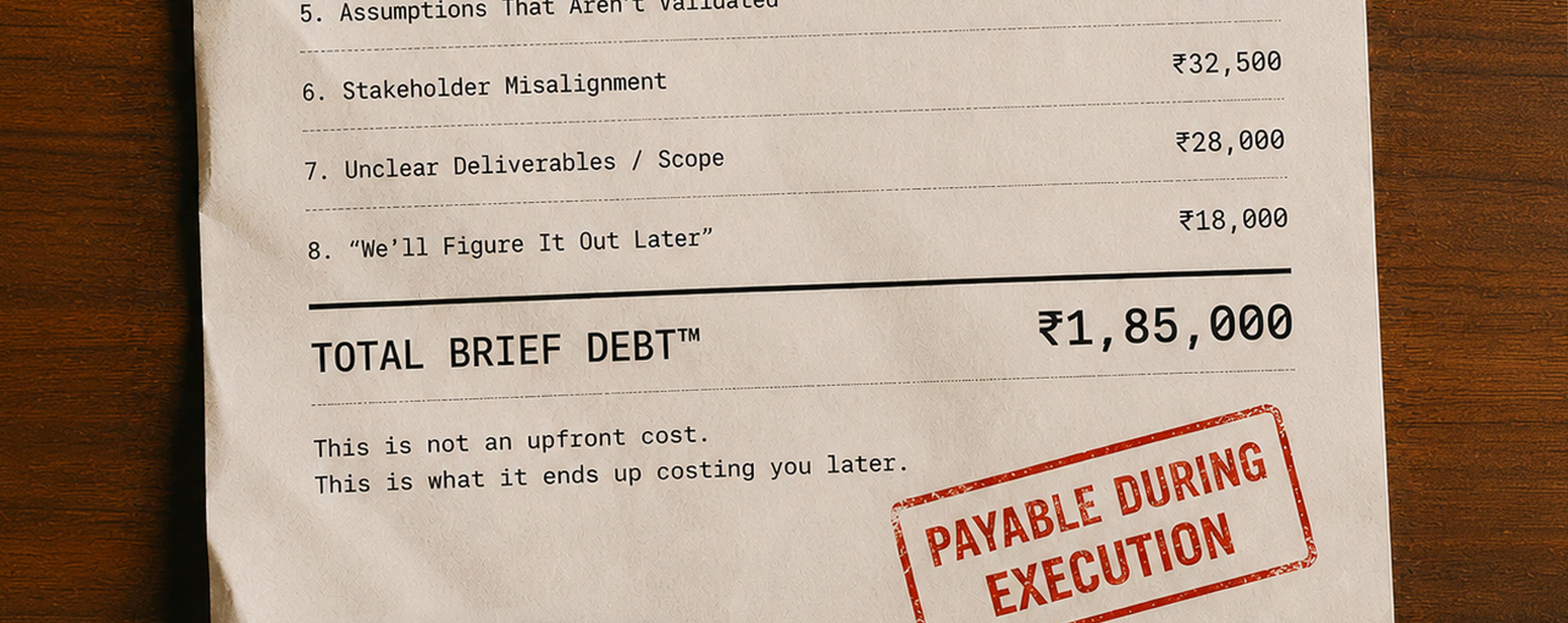
Brief Debt™.is the accumulated cost of ambiguity, assumptions and missing information that enters a project before work begins.
Like technical debt, it may seem harmless at first. But the longer it remains unresolved, the more expensive it becomes.
Why teams don't notice it
A bad brief rarely looks bad.
The kickoff goes well. Stakeholders agree. The brief gets approved and the project starts.
Everything feels aligned.
The cost only appears later, when the work comes back and people realise they were never working from the same understanding in the first place.
That's what makes Brief Debt™ dangerous.
Signs of Brief Debt™
Most projects show warning signs long before they show symptoms.
Watch for:
- Vague objectives
- Undefined audience
- Missing success metrics
- Conflicting stakeholder expectations
- "We'll figure it out later"
- Multiple rounds of revisions
How Brief Debt™ accumulates
The process is surprisingly predictable.
Missing Answer ↓ Assumption ↓ Misalignment ↓ Revision ↓ Delay ↓ Cost
A small gap in a brief becomes an assumption. Assumptions create different interpretations. Different interpretations create revisions.
The debt compounds from there.
The real cost
Brief Debt™ rarely appears as a line item in a budget.
Instead, it shows up as:
- Additional project hours
- Lower profitability
- Team frustration
- Missed deadlines
- Reduced client confidence
The cost isn't paid when the brief is written. It's paid during execution.
This repeats because it's predictable
The briefing happens today. The revisions happen weeks later.
By then, most teams blame the creative, the feedback, the process or the timeline.
Rarely the brief.
That's why the same patterns keep repeating. The cause and the consequence are separated by time, making the connection difficult to spot.
Why Brief Debt™ is so hard to spot
A bad brief rarely looks bad.
It gets approved.
The project starts.
Everyone feels aligned.
The cost only appears weeks later, when assumptions meet reality.
That's what makes Brief Debt™ different from most project problems.
The cause and the consequence are separated by time.
How to reduce Brief Debt™
Ask better questions before work begins.
Review responses for ambiguity.
Challenge assumptions.
Align stakeholders early.
The goal isn't a longer brief. It's a clearer one.
The cheapest time to fix a problem
GudBrief was built around a simple idea:
The cheapest time to fix a problem is before the project starts.
By helping teams identify ambiguity, gaps and weak assumptions early, GudBrief helps reduce Brief Debt™ before it becomes costly rework.